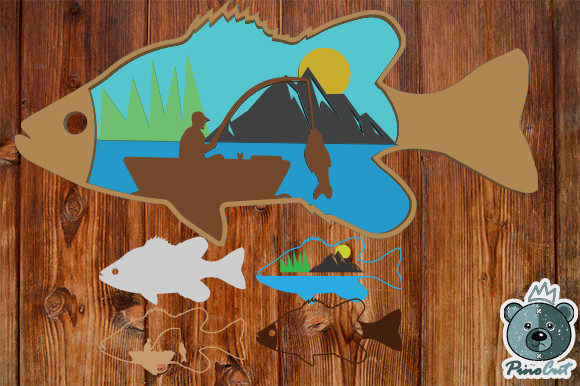
3D Fish: A Streamlined CNC and Laser Cutting Project for Plywood
In the rapidly evolving landscape of digital fabrication, finding a project that balances aesthetic appeal with manufacturing efficiency is often a challenge. The 3D Fish project addresses this need by offering a sophisticated yet accessible design intended specifically for Computer Numerical Control (CNC) milling and laser cutting technologies. This is not merely a static image; it is a comprehensive vector-based blueprint designed to transform flat sheets of material into complex, three-dimensional art pieces. Whether you are a small business owner looking to expand your product line, an educator seeking engaging STEM projects, or a hobbyist eager to master plywood construction, this project provides a robust foundation for execution.
The Core Concept: From Vector to Physical Object
The essence of the 3D Fish lies in its conversion from a two-dimensional electronic format into a tangible, multi-layered structure. Unlike traditional 3D printing, which builds objects layer by layer through extrusion, this method relies on precise cutting and assembly of flat materials. The project utilizes vector drawing technology, ensuring that every curve and angle is mathematically perfect. This precision is critical when working with plywood, where even minor deviations can lead to gaps in the final assembly or structural weaknesses.
The process begins with a high-quality vector file. These files are engineered to be compatible with industry-standard software used for both laser cutters and CNC routers. By providing the design in an editable electronic format, the project empowers users to take full control over their production workflow. You are not locked into a single configuration; instead, you have the flexibility to modify the design layout to suit specific requirements before a single cut is made. This adaptability is a key factor in why the 3D Fish is suitable for mass production, allowing manufacturers to scale output without sacrificing quality or consistency.
Workflow Integration and Preparation
Successful implementation of the 3D Fish project requires a clear understanding of the digital-to-physical workflow. The journey starts immediately after downloading the archived files. Because all necessary components are packaged together, the setup time is minimized, allowing creators to focus on customization rather than troubleshooting missing assets. The first step in any professional workflow involves opening the vector file in your preferred CAD or vector editing software. Here, you can adjust dimensions, resize elements, or alter the arrangement of parts to fit your specific production needs.
For entrepreneurs and marketers, this stage represents a crucial opportunity for branding. The modular nature of the fish design allows for the insertion of logos, text, or custom patterns directly into the vector paths. This capability turns a simple decorative item into a powerful marketing tool. Educators can use this phase to teach students about scaling, proportion, and design logic, while freelancers can demonstrate their ability to customize client requests efficiently. The ability to modify the design prior to cutting ensures that the final product aligns perfectly with the intended vision, reducing waste and rework.
Material Selection and Technical Specifications
While the 3D Fish project is versatile regarding the tools used, the choice of material significantly impacts the outcome. We strongly recommend using 3mm plywood for this specific design. This thickness strikes an optimal balance between structural integrity and ease of cutting. Thinner materials may lack the rigidity required for the interlocking joints, while thicker woods can strain standard laser cutters or require slower, more expensive CNC processing speeds.
Plywood offers several advantages over solid wood for this application. It is dimensionally stable, meaning it resists warping and shrinking, which is vital for maintaining the tight tolerances needed for 3D assembly. Furthermore, plywood is cost-effective, making it ideal for mass production scenarios where profit margins are thin. When preparing your materials, ensure they are free of voids and knots, as these imperfections can cause the cutting head to deflect or the laser beam to burn unevenly. Proper material preparation is a non-negotiable step in maintaining quality control throughout the production cycle.
Execution: Cutting and Assembly Strategies
Once the design is finalized and the material is prepared, the execution phase begins. The vector cutting plan included in the archive is optimized for minimal kerf loss, ensuring that parts fit together snugly. For laser cutting, the process is typically rapid, with the machine following the vector paths to slice through the 3mm plywood with high precision. CNC routers offer a similar level of accuracy but may be preferred if you are working with larger sheets or need to create deeper grooves for assembly.
The assembly process is designed to be intuitive and economical. The 3D Fish utilizes a system of tabs and slots that allow the layers to stack and lock together without the immediate need for adhesives, although glue is recommended for permanent stability. This mechanical interlocking reduces the complexity of the build, making it accessible to beginners while still satisfying the demands of professionals. The design encourages a logical sequence of assembly, starting from the base layers and building upward. This systematic approach minimizes errors and ensures that the final 3D form emerges correctly.
Customization and Finishing Touches
The true potential of the 3D Fish is unlocked during the finishing stage. Once the pieces are cut and assembled, the product serves as a blank canvas for creative expression. Users can paint the fish in any color palette, matching interior decor themes or brand colors. The smooth edges provided by precise laser or CNC cutting make sanding quick and easy, resulting in a professional surface ready for painting or staining.
Beyond paint, the project invites decoration with various elements. Consider adding metallic accents, glitter, or even embedded lighting to create a dynamic visual effect. For educational purposes, different colored layers can represent biological data or artistic concepts. For commercial products, the ability to decorate with unique elements adds value and differentiation in a crowded market. The simplicity of the base design ensures that the focus remains on the creativity applied during this final phase, allowing for endless variations from a single source file.
Economic Viability and Mass Production Potential
From a business perspective, the 3D Fish project stands out due to its economic efficiency. The combination of low material costs, fast production times, and minimal labor requirements makes it highly profitable. The "download, modify, cut" workflow eliminates the need for expensive prototyping phases. If a design change is needed, it can be implemented in the software instantly, without wasting physical materials. This agility is essential for modern businesses that must respond quickly to market trends.
Furthermore, the standardized nature of the files facilitates consistent quality across large batches. In mass production environments, consistency is key to customer satisfaction. Because every unit is derived from the same vector source, the variation between individual fish is negligible. This reliability builds trust with clients and reduces the likelihood of returns due to manufacturing defects. Whether producing a few units for a craft fair or thousands for retail distribution, the project scales seamlessly.
Conclusion: A Practical Tool for Modern Creators
The 3D Fish project represents a convergence of digital design and practical craftsmanship. It is a resource that respects the user's time and expertise by providing a clean, editable, and well-documented workflow. By removing the barriers to entry associated with complex 3D modeling and focusing on the strengths of laser and CNC cutting, this project enables a wide range of users to produce high-quality results. It fits naturally into workflows ranging from personal hobbies to industrial manufacturing, serving as a reliable asset for anyone looking to create impactful wooden designs. With its emphasis on modifiability, material efficiency, and ease of assembly, the 3D Fish is more than just a model; it is a proven strategy for successful digital fabrication.